
Designing Digital Teacher Development for Low-Resource Settings in Nigeria
Digital teacher training must work with limited data, devices and connectivity. This article sets out a practical design approach for Nigerian settings.
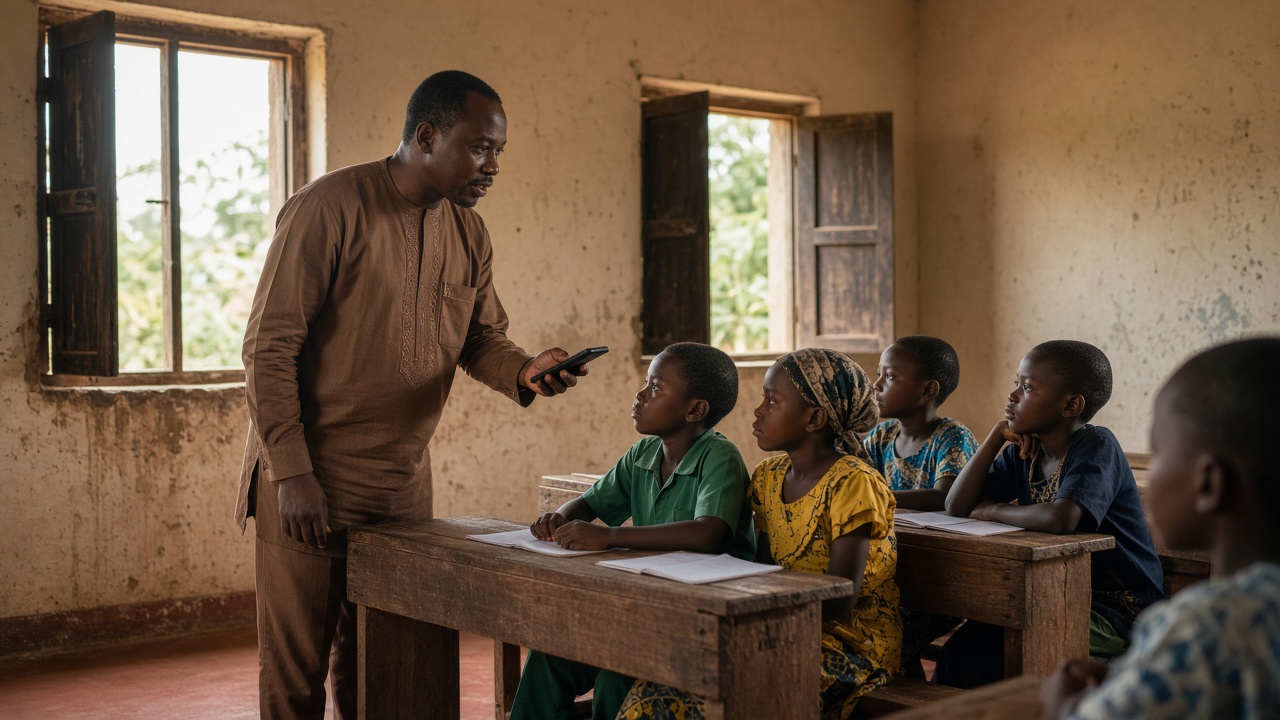
A teacher may own a smartphone and still be unable to complete a digital professional development course. The device may be shared, storage may be full, mobile data may be costly, electricity may be unreliable, and the course may require continuous video access. Even when the content opens, the teacher may have no facilitator to answer a question or a school leader willing to protect time for practice. These conditions should shape the design of digital teacher development in Nigeria. A platform can distribute content, record activity, and connect participants across distance, but it cannot remove the need for relevant instruction, practice, feedback, and school support. The central program question, therefore, is what learning task is needed and what is the least demanding delivery method that allows the intended teachers to complete it and use it in class.
Investigate access as a pattern of use
A device ownership question provides limited information. Program teams need to understand which device a teacher uses, whether it is shared, when it is available, how it is charged, which network works in the area, what data the activity consumes, and whether the teacher can download files. They should also examine digital confidence, language, disability access, and the teacher’s experience with passwords, links, audio, documents, and messaging applications. This investigation should involve teachers from the intended locations and school types. A design tested only with urban participants using recent phones and stable internet can hide barriers facing those with basic devices or intermittent service. Short observation and task testing are often more useful than preference surveys because they show where participation may fail. for example, asking a teacher to open a module, download an audio file, submit a response, and recover a forgotten password reveals where participation may fail. Access can change during a program. Data prices, network quality, device condition, and household demands vary. The design therefore needs more than an entry survey. Instead, a help channel, simple failure reporting, and periodic checks can show whether technical conditions are preventing learning before non-completion is attributed to low motivation.
Choose the lightest channel that can support the learning task
The medium should follow the task. A short text or compressed audio message may be enough to introduce an idea. A downloadable demonstration can model a teaching technique. A live session may support discussion but requires fixed time and better connectivity. By contrast, rehearsal, feedback, and collaborative planning may require small groups, local facilitators, or periodic face-to-face contact. Designers should calculate the participant burden for each component. This includes file size, estimated data use, download time, storage, charging, required applications, and the number of steps needed to complete the activity. A low-bandwidth option should offer the same essential learning objective, not a reduced course that removes demonstration or feedback. Where internet access is weak, printed materials and scheduled calls may provide a dependable route. The World Bank’s Coach program supports continuous professional development through individual coaching, group training, and workshops delivered in person, remotely, or through combined formats. ¹ This range matters because no single channel suits every learning purpose. In Nigeria, the Federal Ministry of Education also provides teacher-facing digital services, including the Ignite platform for lesson planning and collaboration and a national e-learning portal. ² New initiatives should therefore connect with authorized systems, avoid duplicating functions without a clear reason, and stay focused on the learning task and delivery method that best fit intended teachers.
Digital content still needs instructional discipline
Breaking a workshop into online slides does not create effective professional learning. Each module should specify the classroom practice, show what it looks like, let the teacher rehearse it, and provide a route to feedback. for this reason, examples should use relevant curriculum content and classroom conditions. Instructions must remain clear on a small screen and should not depend on decorative animation or long introductions. A useful module can be brief while belonging to a sustained sequence. A teacher might study one technique, review a demonstration, plan a lesson, try the technique, upload a short reflection, or sample of pupil work, and discuss the next attempt with a peer or facilitator. The evidence submitted should be proportionate, avoid exposing pupils, and serve a clear learning purpose. Facilitators require preparation for digital delivery. They need to interpret participant questions, give accurate feedback, monitor silence without assuming disengagement, and redirect conversations to safer channels when personal information appears. Automated reminders can support follow-up, but teachers need to know when they are interacting with a system and how to reach a responsible person.
Equity and safety belong inside product decisions
Digital programs can widen participation and reproduce existing exclusion. Teachers with disabilities may encounter images without descriptions, audio without transcripts or interfaces that do not work with assistive technology. Teachers working in minority-language settings may understand professional content better when key explanations and examples reflect the language of instruction. Women may face different constraints on device access, time, or participation in mixed online groups. These conditions require investigation with affected users. UNESCO’s 2023 Global Education Monitoring Report identifies access, governance, and teacher preparation as system conditions for appropriate technology use in education.³ UNICEF similarly calls for attention to digital and usage divides, teachers and school leadership, and the needs of marginalized users.⁴ Taken together, these principles direct program teams toward participation conditions and institutional responsibility before scale, reinforcing the need to choose the least demanding delivery method that intended teachers can actually use. Privacy also influences design. Platforms may collect identity, contact details, professional records, location, course activity and submitted classroom evidence. Nigeria’s Data Protection Act 2023 provides the national legal framework for processing personal data. ⁵ Programs need qualified advice on lawful purpose, consent where applicable, access, retention, security, and individual rights. They should collect only what the service and evaluation require.
Measure learning and use across different access conditions
Logins, page views, and time online describe platform activity. They do not show whether a teacher understood the content or used it in class. Measurement should therefore distinguish registration, access, completion, demonstrated learning, classroom use, and pupil outcomes. Each stage needs an appropriate method and a clear statement of what the result can support. Technical measures can still inform program decisions. Completion by device type, failed downloads, help requests, data reimbursements, time required per task, and use of offline routes may reveal exclusion. Review these patterns alongside teacher interviews and facilitator records. for instance, a low completion rate in one location may reflect network or scheduling conditions rather than teacher quality or topic relevance. Evaluation should compare delivery routes where feasible. Program teams might test compressed audio against text for explanation, asynchronous discussion against live sessions, or remote feedback against a combined model. The aim is to identify a workable route for the intended teachers. Any claims about classroom practice or pupil learning require evidence beyond platform analytics.
A responsible pilot begins with the hardest access case
A useful pilot could select teachers in a defined subject or phase across locations with different access conditions. Partners would agree on one classroom practice, the essential learning sequence, the minimum device requirement, offline alternatives, support arrangements, and measures. The takeaway is that testing should include participants expected to face the greatest barriers, since their experience is likely to reveal design assumptions early. Achieva Africa could contribute teacher user research, professional learning pathway design, participant support, and analysis of engagement across delivery routes. Curriculum authority, professional recognition, school management, data governance, and formal evaluation must remain with institutions authorized and qualified to perform those functions. The organization should connect to existing public systems where appropriate and accurately describe its role. The takeaway is to support design and analysis while preserving institutional authority. Success would mean that teachers with different access conditions could reach the same essential content, practice a relevant technique, obtain useful feedback, and apply the technique again. It would also mean that program managers could see who was excluded, understand why, and adjust the service. In this way, the outcome would be a stronger basis for digital teacher development than the number of accounts created, or videos uploaded, because it would show that the design matched the learning task and delivery method to teachers’ real conditions.
References
-
World Bank. Coach: Helping Countries Accelerate Learning by Improving In-Service Teacher Professional Development. 2026. https://www.worldbank.org/en/topic/teachers/brief/coach-helping-countries-accelerate-learning-by-improving-in-service-teacher-professional-development
-
Federal Ministry of Education Nigeria. National e-learning portal and Ignite teacher platform. 2026. https://education.gov.ng/
-
UNESCO Global Education Monitoring Report. Technology in Education. 2023. https://www.unesco.org/gem-report/en/publication/technology
-
UNICEF. Pulse Check on Digital Learning. 2022. https://www.unicef.org/reports/pulse-check-digital-learning
-
Federal Republic of Nigeria. Nigeria Data Protection Act 2023, official text hosted by Policy and Legal Advocacy Centre. 2023. https://placng.org/i/wp-content/uploads/2023/06/Nigeria-Data-Protection-Act-2023.pdf

Bright Chimezie Irem is Co-Founder and Chief Operating Officer (COO) of Achieva Africa, where he leads research and development, program and project management, business strategy, scaling, and innovation. He contributes to shaping Achieva’s long-term direction by developing practical programs, systems, and solutions that address the evolving professional needs of educators and schools. His experience spans healthcare, pharmaceutical systems, climate and health, enterprise development, and community programs. As Founder and Group Managing Director of AfriPharm Medicals Group, and through his work with Climate Resource Center Nigeria,…
More From This Author
Join The Conversation
Share a thoughtful perspective. Comments are reviewed before appearing publicly.